Have you ever experienced burnout with your training and rehab? Maybe you felt it physically, or maybe you just struggled managing the mental/emotional side of your training. Burnout in athletic populations isn’t always about “doing too much” and excessive training loads. It is a multifaceted stress response in which mental, physical, and emotional states can influence each other. The three distinctive qualities in a burnout response include exhaustion, cynicism and detachment, and a lack of perceived accomplishment or effectiveness. (Maslach, Christina, and Michael P. Leiter ).
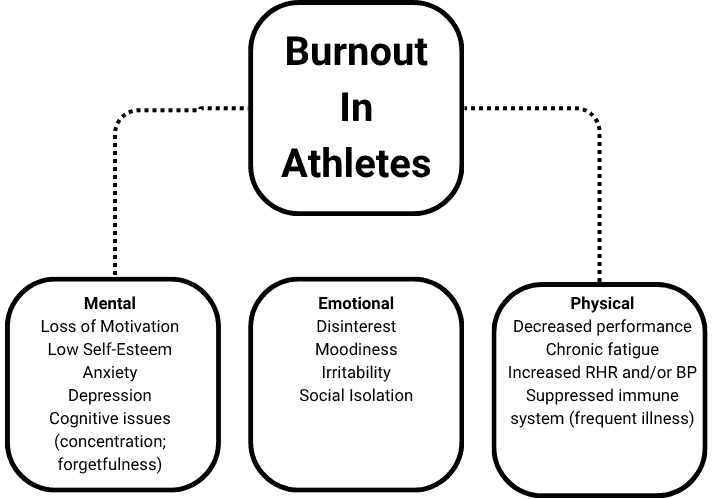
When we get to that place, it can be hard to stay engaged with your training. Progress feels stalled and out of your control. Effort and progress sometimes start to look disproportionate.
If you’ve even trained or rehabbed in a burnout phase, you know that simply trying harder doesn’t always work. That is where introducing more “play” can be beneficial. In this context, play is not “just about having fun.” It is about creating an environment that can reduce an athlete’s cumulative physiological and psychological stress over time. The goal is to make adjustments that change how training stressors are interpreted (Gray, Peter).
So how does play help with burnout? How can we create more of it in our training and rehab environments? Well, first we need to understand how burnout happens. Research shows this is most likely to occur in conditions where stressors, threats, and demands are high, while perceived control is low or lost (Maslach, Christina, and Michael P. Leiter). This can look like:
- Chronic training overload and/or insufficient recovery
- Reduced autonomy in training and competition
- Total life stressors (work, family, etc.)
- Lacking adequate outlets for support
- Perfectionism and internalized “more is better” beliefs
- Injury or loss of control over performance capacity
- Setbacks in injury rehabilitation
Choosing play can be a powerful framework for influencing control, autonomy, and decision-making. We change our training environments to “off-load” some additional demand while we focus on rebuilding physical and/or emotional capacity. Play does not have a singular definition. Instead, it involves several different characteristics. In this case, play is defined by five distinct characteristics (Gray, Peter).
| Characteristic of Play | Athlete Benefit | Example |
| Self-chosen and self-directed behavior | Promotes autonomy over expectations | On your next conditioning day, keep the prescription, but choose how you want to complete it |
| Intrinsic motivation | Engagement is focused on the task itself, not the outcome | Leaving your watch at home. Train for feel, and reduce pressure to track performance data. |
| Bounded structure with rules | Constraints guide behavior without rigidity | Keep your run/workout, but modify the environment. Maybe you try a new route, run with a group or partner, etc. |
| Creativity | Freedom to explore variable solutions | Trying a new squat variation in your next program to learn a new skill. Maybe tempo, loading pattern, etc. Explore the movement. |
| Engagement within tolerable stress limits | Ability to regulate intensity or disengage when overload occurs | Giving yourself permission to reduce intensity, shorten session, or modify training with excessive spikes in fatigue or stress |
Training in this way can allow athletes to find ways to engage in sport, rehab and training that shifts the emphasis away from performance and outcome goals. This can be particularly useful when you’re an athlete in a burnout state. Or, if you’re an athlete hoping to avoid burnout from occurring, these might be worth sprinkling into your training as a preventative measure.
Works Cited:
Barker, Joanne. “Preventing Burnout in Young Athletes – Boston Children’s Hospital.” Boston Children’s Answers, 29 Oct. 2024,
answers.childrenshospital.org/preventing-burnout-young-athletes/.
Gray, Peter. “Definitions of play.” Scholarpedia, vol. 8, no. 7, 2013, p. 30578, https://doi.org/10.4249/scholarpedia.30578.
Maslach, Christina, and Michael P. Leiter. “Understanding the burnout experience: Recent research and its implications for psychiatry.” World Psychiatry, vol. 15, no. 2, June 2016, pp. 103–111, https://doi.org/10.1002/wps.20311.
Miller, Lexi. “Understanding How Athlete Burnout Happens and How to Prevent It.” TrainingPeaks, 15 Oct. 2024, www.trainingpeaks.com/coach-blog/understanding-burnout-how-prevent/.
Neal, Timothy. “Burnout in Athletes.” NATA, Apr. 2016, www.nata.org/nata-now/articles/burnout-athletes.
Thompson, Blake. “Denying Fate: Envisioning an Answer to Burnout in Play – Seattle Psychiatrist.” Seattle Anxiety Specialists – Psychiatry, Psychology, and Psychotherapy, Seattle Anxiety Specialists – Psychiatry, Psychology, and Psychotherapy, 22 Apr. 2024, seattleanxiety.com/psychiatrist/2021/10/7/denying-fate-envisioning-an-answer-to-burnout-in-play